Newport Beach, California

Your team is doing work your software should be doing.

We build AI-powered systems that automate the busywork, connect your tools, and show you exactly where your revenue is coming from.

Most AI projects fail because somebody sold software before understanding the business. We start with how your business really runs, then build only what earns its place.

No cost, no pitch deck. We look at your current tools and I tell you where AI would help, and where it wouldn't.


What you get when we work together

Not a polished proposal from one person and a build from somebody else. Here's how we work, and what that means for the thing you end up with.

You get me, not an account manager

The person who sits in your discovery call is the person who maps your business and the person who writes the code. Nothing gets lost in a handoff, because there isn't one, and you never explain your business twice.

I'll tell you when the answer is no

A lot of what gets called an AI problem is really a broken intake form, one tool too many, or a process nobody ever wrote down. If that's your situation I'll say so on the call, for free. I'd rather lose the project than sell you something you don't need.

I stay after it ships

Systems meet reality the day real people start using them, and reality always has opinions. I don't hand over a document and disappear. I watch how it gets used in practice and keep tuning it until it earns its keep.


What we've built, and what it's for

Systems we've designed and built end to end. Here's what each one does, and the kind of business it fits. If one of them sounds close to your problem, the pieces transfer.

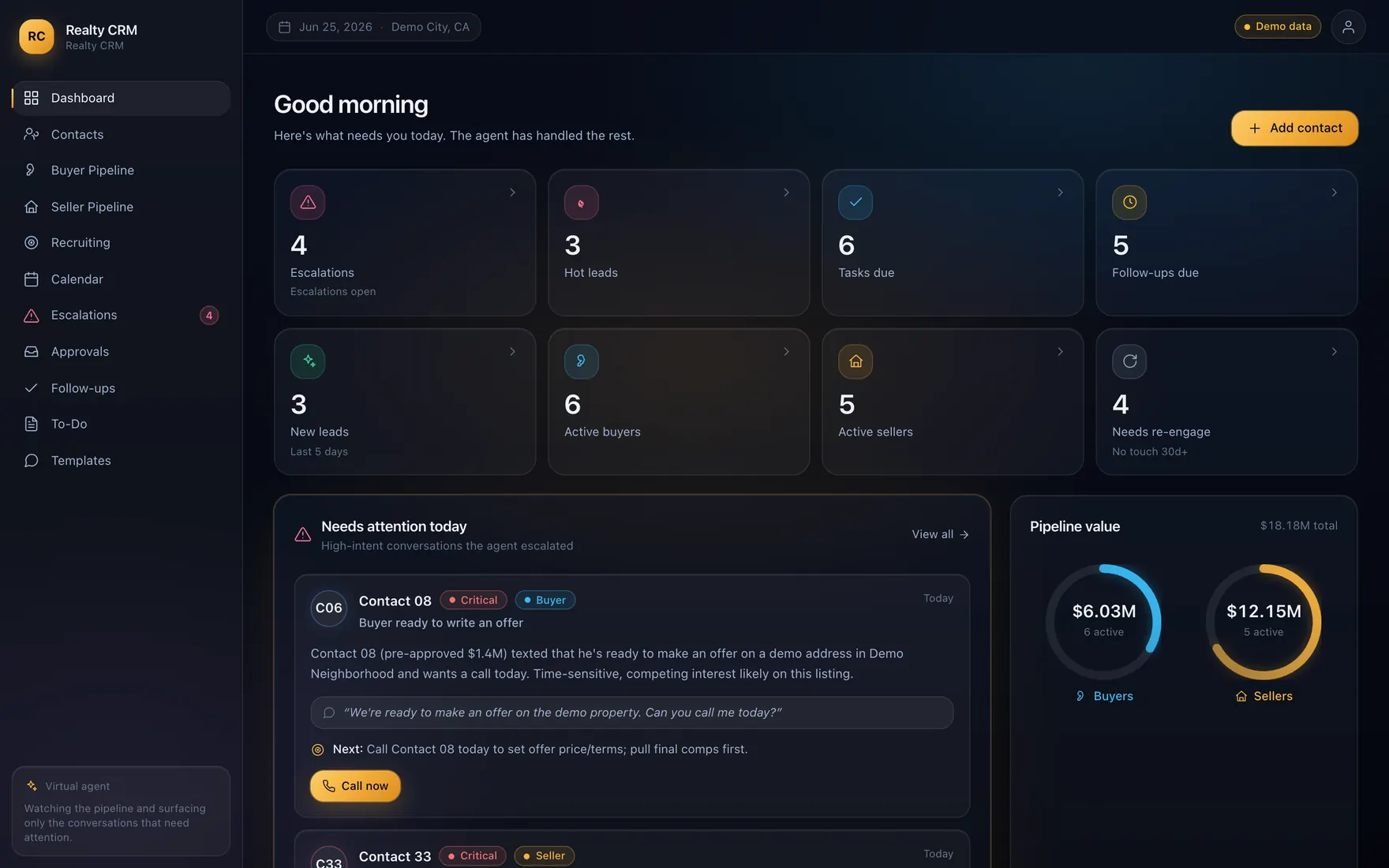
A CRM dashboard listing open escalations, hot leads, tasks due and follow-ups, with a panel of conversations flagged for a callback and two pipeline value dials.
Interface shown running on demo data
Sales CRM with an agent layer

A pipeline that tells you who to call, instead of a list you have to read

Contacts, buyer and seller pipelines, tasks and approvals in one place, with an automated layer watching the pipeline underneath. Rather than handing an owner another dashboard to scan, it reads the conversations, decides which ones are time-sensitive, and surfaces only those with the reason attached and a suggested next step. Everything else stays handled and out of the way.

Built for

  • Sales teams whose follow-up depends on somebody's memory
  • Owners who want the exceptions, not another report
  • Businesses where a slow callback loses the deal
  • Any pipeline currently living across a spreadsheet and an inbox
  • Next.js
  • Cloudflare
  • Supabase
A venue booking console showing revenue for the month, pending approvals, today's events with setup and cleanup windows, and an alerts panel flagging a date conflict between two bookings.
Interface shown running on demo data
Membership & venue operations console

Applications, members, and room bookings that stop colliding with each other

One console for reviewing applications, holding member records, and booking the room. The booking side checks the calendar for conflicts and setup and cleanup buffers before anything is confirmed, so two events cannot quietly land on the same evening. Decisions write a clear record rather than living in somebody's sent folder.

Built for

  • Membership organizations reviewing applicants on a rolling basis
  • Venue and room booking where a double booking costs real money
  • Teams running a recurring event calendar by hand
  • Anyone whose approvals currently happen over email
  • Next.js
  • Cloudflare
  • Supabase
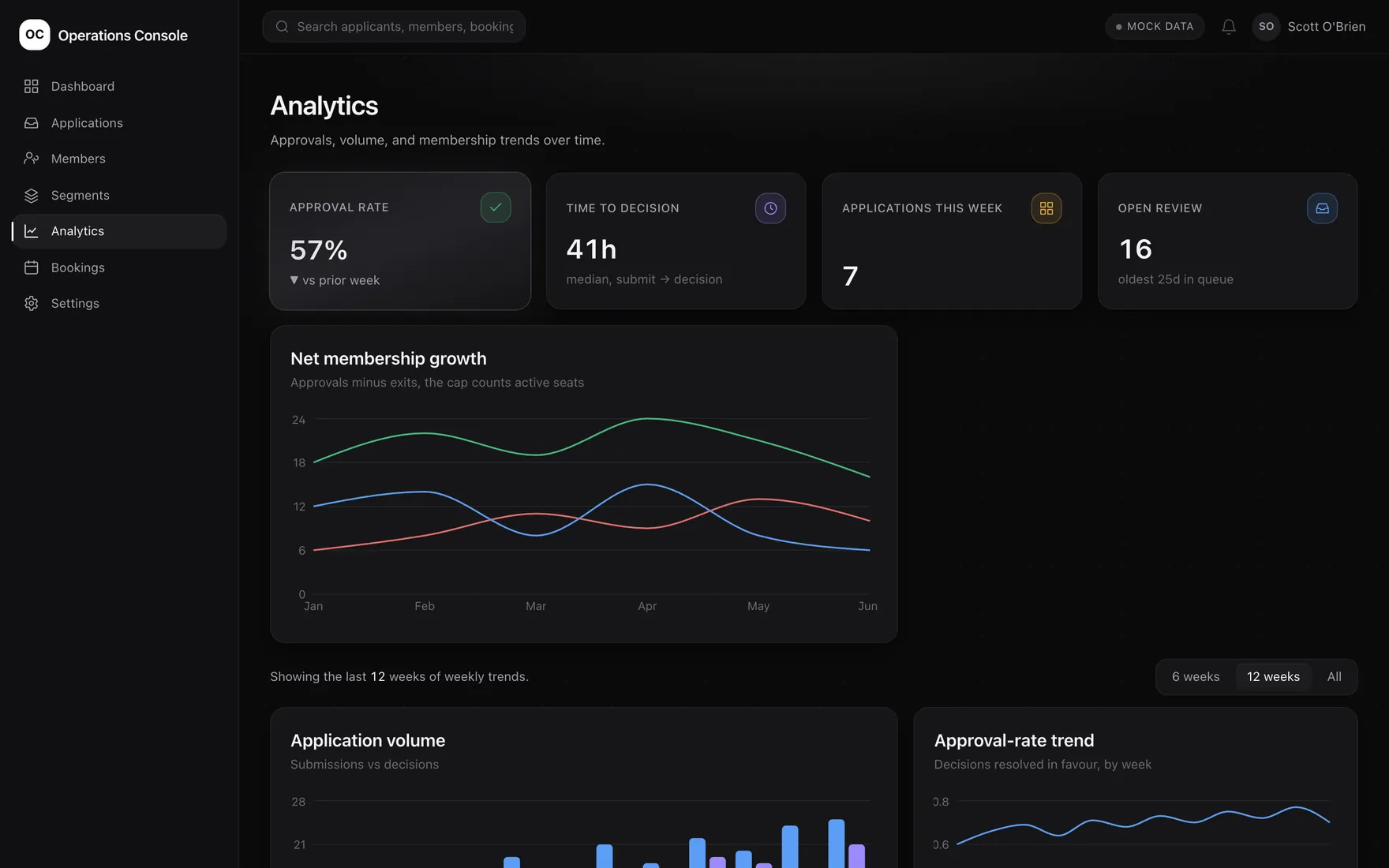
An analytics view with approval rate, median time to decision and weekly volume, above trend charts for net growth, application volume and approval rate.
Interface shown running on demo data
Reporting layer

The numbers an owner will open on a Monday

Most reporting fails because it answers questions nobody asked. This is the opposite: a small number of measures tied to decisions someone has to make, like how long a decision is taking and whether the trend is moving the right way. It reads from the same database the operational systems write to, so there is no separate export step and no version that disagrees with the other version.

Built for

  • Owners rebuilding the same spreadsheet report every week
  • Teams where two systems report two different numbers
  • Anyone who needs a trend, not a snapshot
  • Supabase
  • Next.js
Automated reminders & intake

A reminder engine that replaces the spreadsheet chase

Intake forms feed one database instead of four inboxes. From there the system schedules text message reminders at the right point in each record's life, tracks what was sent and what came back, and posts updates to the team's project board so nothing depends on somebody remembering to check. Built with the consent handling and opt-out rules that text messaging requires, not bolted on afterwards, and with hard limits on how much it can ever send in one run.

Built for

  • Renewal and expiry deadlines: policies, contracts, memberships, licences
  • Appointment and service reminders that reduce no-shows
  • Any team tracking recurring dates in a shared spreadsheet
  • Businesses whose follow-up quietly depends on one person's memory
  • Supabase
  • Telnyx SMS
  • Monday.com
  • Jotform

Different businesses, same underlying parts: a clean data layer, automated messaging that respects the rules, and a view an owner will open. That's why this transfers. If your problem rhymes with one of these, most of the thinking is already done. See these in more detail.


Small, working, proven. In that order.

No twelve week discovery phase, no roadmap you pay for and never use. The point is to get one real thing running in your business early enough that you can judge us on it.

01

Sit with the business

Not the org chart. The real path a lead takes, who touches it, and where it goes quiet. Usually the bottleneck is somewhere nobody thought to mention.

02

Find the leverage

There are normally two or three places where the work is repetitive and the data already exists. Those are worth automating. Most of the rest isn't, and we'll say which is which.

03

Build one thing well

One working system before any talk of a platform. You should see something running, in your business, with your data, before you commit to anything bigger.

04

Stay and tune it

Real people use software differently than planned. That's expected, and it's the part where a system either becomes indispensable or quietly gets abandoned.


What we build

Four things, done properly, around the tools you already use. If what you need isn't here, say so on the call and I'll tell you honestly whether I'm the right person.

Automation & Workflow

Take the repetitive work off your team. Lead routing, follow-up sequences, document handling, notifications, and the reporting somebody currently rebuilds by hand every Monday.

  • Connect the tools you already pay for
  • Automate handoffs that depend on memory
  • Replace manual reporting with something scheduled

CRM & Lead Tracking

Know where every lead came from, who owns it, and what happened next. Built around your sales process rather than forcing your team into someone else's.

  • Lead capture and source tracking
  • A pipeline you can see at a glance
  • Follow-up that doesn't rely on a sticky note

Marketing Attribution

Stop optimizing toward form fills. Connect campaign spend to closed revenue so you can see which channels are earning their budget and which are quietly burning it.

  • First touch through to closed revenue
  • Call and form tracking tied to source
  • Feed real outcomes back to the ad platforms

Custom AI Tools & Internal Knowledge

The things off-the-shelf software won't do for your business. Internal assistants, searchable SOP libraries, operational dashboards, and industry-specific tools built for how your team really works.

  • AI assistants trained on your own documentation
  • Searchable internal knowledge instead of tribal memory
  • Dashboards built around decisions, not vanity numbers

Who this is for, and who it isn't

A bad fit wastes your money and our time. It's cheaper for both of us to work that out in the first ten minutes.

Probably a good fit

  • You're a growing service business and the admin is growing faster than the revenue.
  • Your leads live in a mix of inboxes, spreadsheets, and somebody's head.
  • You're spending real money on marketing and can't trace what it produced.
  • You have software you pay for and barely use, and you suspect it should be connected.
  • You want the person building it to understand the business, not just the code.

Probably not a fit

  • You want an AI feature mainly so there's something to announce.
  • You're shopping purely on price. I'm not the cheapest option and won't pretend to be.
  • You're pre-revenue and still testing whether the business works at all.
  • You want AI to replace your team. We build things that make a team faster, not smaller.
  • You need a large agency with 24/7 staffed support. That's a real need, and it isn't us.
Scott O'Brien, founder of Veris AI

I'm not a developer who learned business. I'm an operator who learned to build.

I spent years in sales, business development, and operations before I wrote systems for a living. That order matters. It means when you describe the thing that's driving you crazy on a Tuesday afternoon, I've usually been on the other end of it.

I started Veris AI because I kept watching good businesses get sold expensive software that solved a problem they didn't have. The gap was never the technology. It was that nobody took the time to understand the business first, and then went and built the thing.

What I care about

That the people using what I build have a better week because of it. Software that makes somebody's job worse is a failure no matter how clever it is.

That you can see the value. If I can't point to what a system saved you or made you, I haven't finished.

That you're told the truth, including when it's inconvenient for me.


The best part of my week isn't billable

I host vibe coding sessions here in Orange County, and I'm active in the local business and AI communities.

Most of that time is spent sitting with people and working through whatever they're stuck on. An AI tool that won't behave. A process quietly eating their week. Something they're trying to build and can't get over the line. No pitch, no scope document, no invoice at the end of it.

I do it because I genuinely like it. It also means I'm rarely guessing about what operators are dealing with, because I hear it in person, in detail, long before it ever becomes a project.

  • Vibe coding sessions: hands on building, not a lecture
  • Most of it is helping people get unstuck with AI, for free
  • It's why I usually understand your problem before you've finished describing it
Scattered signals resolving into a connected system and a measured, rising trend

The questions people really ask

Including the ones most consulting sites leave off.

What does a project cost?

Most engagements start with a scoped first build in the low four figures to low five figures, depending on how many systems have to talk to each other. We quote a fixed price for a defined piece of work before anything starts, so there's no meter running. If ongoing tuning makes sense afterwards, that's a separate monthly arrangement you can stop whenever you want.

How long before I see something working?

The goal is one working piece inside the first few weeks, not a six month roadmap. I'd rather you see something real running in your business early and decide from there whether you want more. It's a better deal for you and it keeps me accountable.

Do I have to replace the software I already use?

Almost never. Most of the value is in connecting what you already pay for. Rip and replace projects fail on adoption, your team already knows the current tools, and you've already bought them. I'd rather make that stack work properly than sell you a migration.

What if AI isn't the right answer?

Then I'll tell you on the call, and it won't cost you anything. A lot of what gets labelled an AI problem is a broken intake form, one subscription too many, or a process nobody ever wrote down. I'd rather lose the project than take your money for something that won't move the needle. That isn't charity, it's just a better long game than a client who regrets hiring me.

Who owns what you build?

You do. Systems run in your accounts, on your infrastructure, under your billing, with your name on the vendor relationships. If we stop working together nothing switches off and nothing is held hostage. Lock-in is a business model, not an architecture.

What happens to my business data?

It stays in your systems. We work inside your accounts rather than copying your data into ours, we don't sell or share anything, and I'll sign an NDA before you show me anything sensitive. What we keep on our side is the boring stuff: notes, scope, and invoices.

Let's find out how I can help

A discovery call is a real conversation, not a pitch. Bring the thing that's annoying you most and we'll look at it together.

  • About 30 minutes, no cost, no obligation
  • We walk through your current tools and where the work piles up
  • You leave with my honest read, including if that read is "don't spend money on this yet"

Prefer email? support@veris-ai.com. I answer my own inbox.